Quantifying non-API proppant transport and fracture permeability as a function of solids loading and particle shape
Abstract
The use of non-API proppant in hydraulic fracturing has the potential to significantly reduce the cost of hydraulic fracturing operations. However, the influence of particle angularity on proppant transport in rough fractures is not well understood. This work utilises direct numerical simulation (DNS) to quantify changes in fracture permeability as a function of proppant aspect ratio, solid volume fraction, and fracture width. High-fidelity simulations of proppant transport through realistically-textured fractures were conducted using an established numerical framework based on the lattice Boltzmann method and discrete element methods. Particle angularity was captured via clumps of overlapping spheres and the fracture surfaces were described by a power spectral density. The results show that fracture permeability, which is a proxy for injection pressure, smoothly decreases with increasing proppant concentration for all proppant and fracture characterisations. No distinct screen-out was observed, irrespective of particle shape, which contradicts the prevailing assumption that screen-out instantaneously occurs at some threshold of proppant concentration and fracture width. Interestingly, the change in fracture permeability with particle angularity was found to be non-monotonic (decreasing, then increasing, and then decreasing again). It is hypothesized that increases in permeability are a result of the preferential alignment of particles with the flow streamlines. This requires further investigation, along with the analysis of more complex clump shapes such as triangles and tetrahedra. The developed permeability-concentration curves clearly show the influence of particle angularity on injection pressure and can be used to help inform operational decision making when non-API proppant is proposed in reservoir stimulation.
Hydrodynamic clogging of micro-particles in planar channels under electrostatic forces
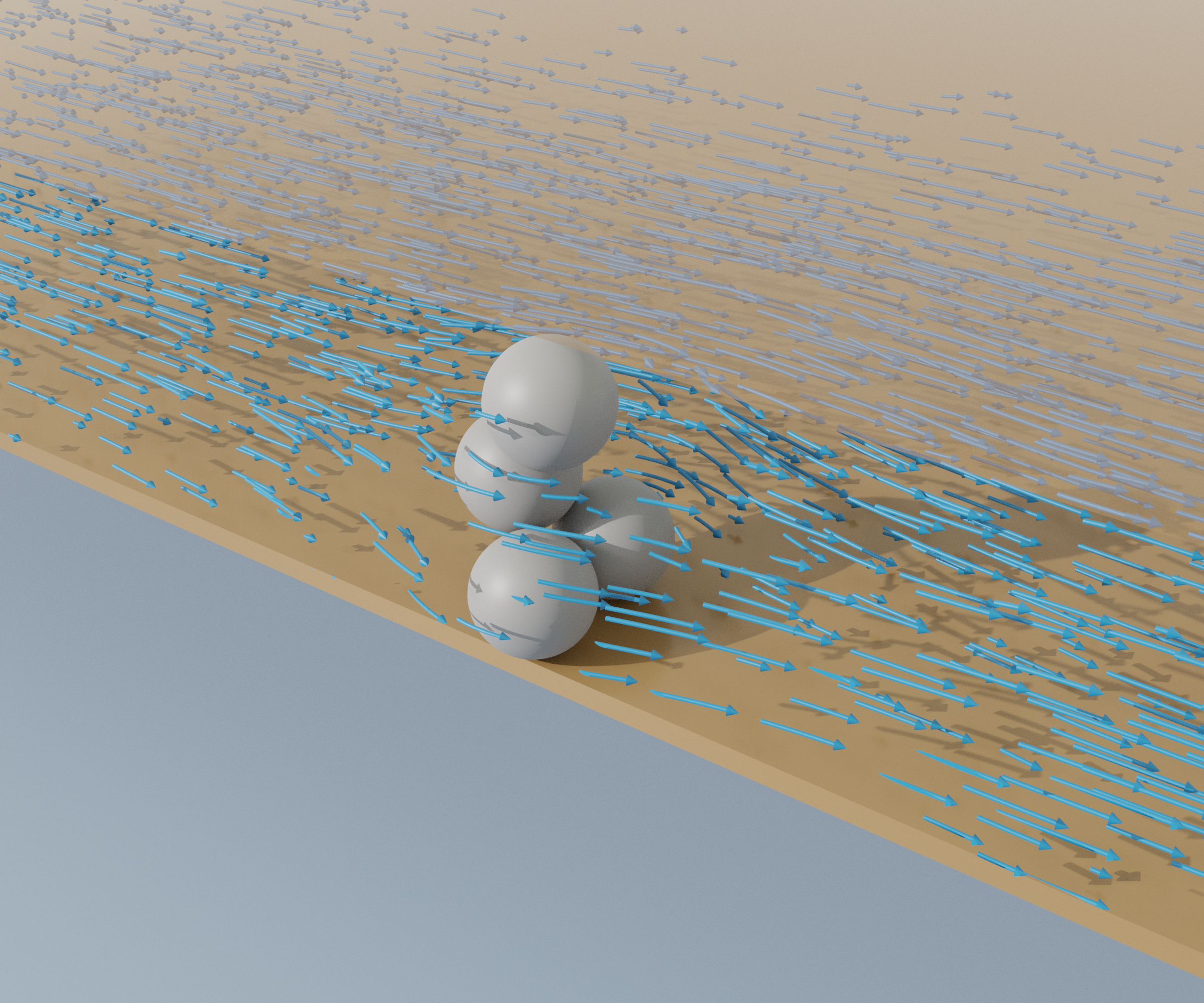
Particle clogging can occur in any scenario where a flow path or constriction is small relative to the size of objects trying to pass through it - think of flow through silos, blood flows through needles, and even the evacuation of crowds through barrieres. It originates from the formation of a single arch, behind which an entire flow path can become blocked. This work is the first time hydrodynamic clogging has been thoroughly investigated in planar channels. We also studied the effects of electrostatic forces, which become significant for micro-particles.
Computational Analysis of Proppant Transport and Screen-Out in Natural and Induced Fractures
Abstract
Predicting the pressure drop (or, equivalently, the effective permeability) across a fracture due to proppant injection is integral to the design of hydraulic fracturing treatments. This theoretical study investigates the relationship between permeability and proppant solid volume fraction, φ, for synthetic rough fractures via direct numerical simulation. For high aperture widths, it is found that permeability decreases in accordance with the cubic law with viscosity adjusted to that of a suspension. This is commensurate with what is currently employed in commercial hydraulic fracturing simulators. Moreover, permeability decreases with increasing fracture roughness. In narrow fractures, however, the permeability deviates further due to arching and localised clogging. However, screen-out, or complete fracture clogging, does not occur instantaneously. Instead, fracture permeability decreases as a continuous function of increasing φ, with gradually-increasing arching and localised clogging. The current binary criteria used by hydraulic fracturing simulators, which model a discontinuous jump in permeability at some φ, are therefore not reflective of the reality of particle transport in rough fractures because they grossly under-predict the permeability. Instead of the existing apparent viscosity and binary screen-out models, the permeability decline curves which are presented in this work should be incorporated into simulators as corrections to the cubic-law fracture permeability.
Probabilistic Quantification of Size Segregation and Screen-Out of Microparticles Subject to Electrostatic Forces
Abstract
A growing number of hydraulic fracturing stimulation treatments rely solely on the deployment of 100-mesh (i.e. 150μm) proppant. Further, these may be preceded by post-pad injection of microparticles (i.e. 5-75μm) with the intent of activating natural fractures. The objective of this work is to describe fundamental new insights on the behaviour of polydisperse microparticle suspensions in hydraulic fractures in terms of screen-out and leak-off. This study was undertaken using a high-fidelity computational model of suspension transport based on the lattice Boltzmann method (for fluid mechanics) and discrete element method (for particle mechanics). The approach has been previously validated against analytical solutions and experimental data for suspension flows in channels, and applied to study fundamental aspects of size segregation and clogging (i.e. screenout) of microproppant. This fully-resolved modelling approach captures two-way hydrodynamic coupling, electrostatic interactions, fracture roughness and tortuosity, and non-Newtonian fluid rheology. The sole assumption of significance is that particles are assumed to be perfectly spherical. One of the challenges of deploying micron-scale proppant in hydraulic fracturing stimulation treatments is poor control of the particle size distribution. This inevitably results in a proportion of the injected proppant being small enough to be susceptible to electrostatic (rather than just mechanical and hydrodynamic) forces. This study clearly demonstrates the increased probability of screen-out that results as a consequence of electrostatic particle-particle and particle-wall interactions, and shows how this effect reduces as the minimum particle size increases. Analysis of particle leak-off off into transverse cleats also demonstrated how the combination of cleat width and particle size result in the formation of occlusions at cleat intersections, the reduction of leak-off rates in cleats, and the retardation of proppant transport in the primary fracture. These findings are significant because tight size control is not economically feasible for microproppant, and so hydraulic fracture engineering must accommodate their characteristic behaviours. This will result in more effective stimulation of coalbeds, but is applicable to all jobs where small proppant is proposed for injection into natural fracture systems.
Influence of particle polydispersity on bulk migration and size segregation in channel flows
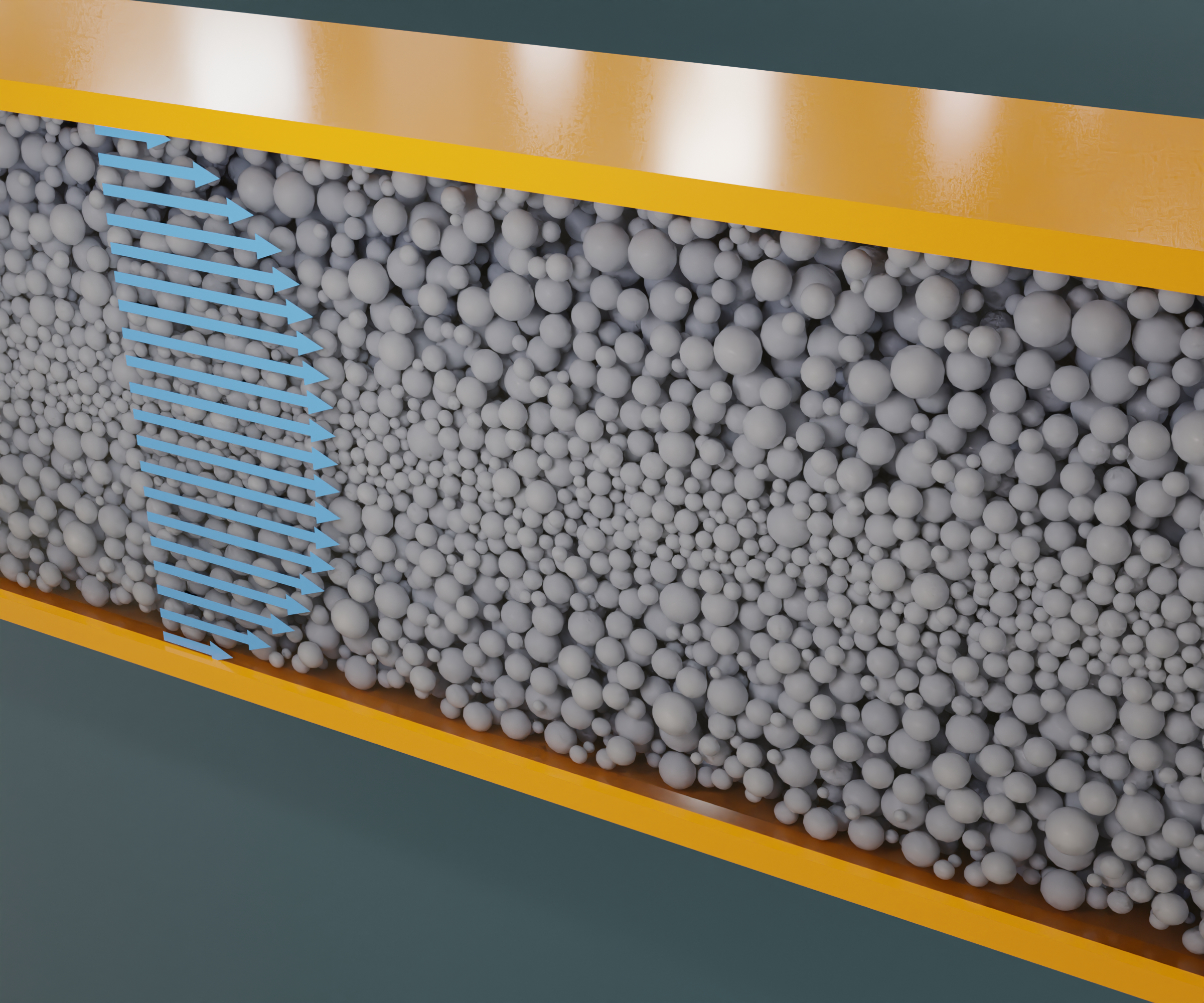
In this work we investigated the phenomenon of shear-induced migration for polydisperse suspensions for the first time. Shear-induced migration is basically the diffusion of particles in the direction of decreasing shear rate, caused by the accumlation of random particle collisions in sheared flows. In channels, it results in the accumulation of particles at the channel centre and a flattening of the velocity profile. These concepts have long been established and investigated for monodisperse suspensions (all particles of the same size), and some works have even investigated bidisperse suspensions (particles of two different sizes), demonstrating that the larger particles preferentially migrate towards the channel centre.
Implications of Recent Research into the Application of Graded Particles or Micro-Proppants for Coal Seam Gas and Shale Hydraulic Fracturing
Abstract
Low permeability, naturally fractured reservoirs such as coal seam gas (CSG, coalbed methane or CBM) and shale gas reservoirs generally require well stimulation to achieve economic production rates. Coupling hydraulic fracturing and micro-proppant or graded particle injections (GPI) can be a means to maximise hydrocarbon recovery from these tight, naturally fractured reservoirs, by maintaining or improving cleat or natural fracture conductivity. This paper presents a summary of the National Energy Resources Australia (NERA) project “Converting tight contingent CSG resources: Application of graded particle injection in CSG stimulatio"n - which assessed the application of micro-proppants, providing guidance on key considerations for GPI application to CSG reservoirs. Over the last decade, laboratory research and modelling have shown the benefits of the application of GPI to keep pre-existing natural fractures and induced fractures open during production of coal reservoirs with pressure dependent permeability (PDP). Laboratory studies, within this study, provide further insight on potential mechanisms and key factors, including proppant size and optimum concentration, which contribute to the success of a micro-proppant placement. Accompanying numerical modelling studies will be presented that describe the likely fluidized behaviour of micro-proppants (e.g., straining models, electrostatic effects, and ‘screen out’ prediction). This paper outlines the necessary reservoir characterization, treatment considerations, and key numerical modelling inputs necessary for the design, execution, and evaluation of GPI treatments, whether performed standalone or in conjunction with hydraulic fracturing treatments. It also provides insight on the practical application of GPI efficiently into fracturing operations, minimizing natural and hydraulic fracturing damage effects, thereby maximizing potential production enhancement for coals, shales and other tight, naturally fractured reservoirs exhibiting pressure-dependent permeability effects.
A Novel Methodology for Predicting Micro-Proppant Screenout in Hydraulic Fracturing Treatments
Abstract
Screenout of micro-proppants in narrow fractures is a significant issue for this emerging stimulation technique, however the predictive tools currently used in hydraulic fracturing simulators are inadequate. This work investigates screenout using numerical simulations. Data from the numerical test cell is translated to regions of screenout, which are dependent on the proppant solid volume fraction, ø, and the ratio of fracture width to proppant diameter, w/d. The dependence on w/d which is demonstrated is commensurate with existing bridging modelling. The method of numerical simulation, however, allows further insight into the underlying mechanisms of screenout, namely collision frequency and bridge stability. Incorporation of the screenout regions into a hydraulic fracturing simulator significantly improves the current industry standard of using a threshold of w/d = 2.5, at similar computational cost during the hydraulic fracture simulation. The screenout regions can be readily reproduced for any desired modification of parameters, such as friction, by modifying the numerical simulations. This is done here in the presence of electrostatics, and is the first time a methodology has been presented which can incorporate electrostatic parameters into screenout predictions of hydraulic fracturing simulators. Overall, the methodology significantly improves the efficacy of screenout predictions by considering the underlying parameters.
Hydrodynamic and electrostatic jamming of microparticles in narrow channels
Abstract
In fluid-driven particulate flows through channels, jamming occurs when static bridges of particles form as the channel becomes narrow relative to the particle size. For micro-sized particles, however, the significance of electrostatics relative to hydrodynamics must be considered. The present work develops a numerical framework based on the inclusion of DLVO theory in fully-resolved lattice Boltzmann method-discrete element method (LBM-DEM) simulations. Strong dependence of jamming on the ionic strength of the fluid medium is demonstrated. Further, continuous functions are fit to the probabilistic jamming data, representing a novel approach to predicting the onset of jamming compared to existing empirical models.
Modelling micro-proppant transport in stress-sensitive naturally-fractured reservoirs
Abstract
Optimal proppant placement is critical to maintaining productivity from stress-sensitive reservoirs, in which gas conductivity depends on the connectivity of the network of secondary fractures to the wellbore. In a colloquial sense, this research places micro-proppants in induced and natural fractures, shows how they are excluded from reaching far into the reservoir, and describes which sizes of proppants this occurs for. Micromechanical modelling of a hydraulic fracturing fluid, in which the hydrodynamics between the fluid and solid phases are fully resolved, is achieved via the lattice Boltzmann method (LBM) for fluids coupled with the discrete element method (DEM) for particles. It is shown that proppant transport along the primary hydraulic fracture channel is strongly inhibited by leak-off into the secondary fracture system. This leak-off is strongly affected by the migration of particles across the fracture width, which in turn is a function of reservoir and treatment properties. A novel numerical approach is proposed for predicting proppant transport through the secondary fracture system, with far-reaching applications to porous media particulate transport.
Development of predictive models in support of micro-particle injection in naturally fractured reservoirs
Abstract
New models for particle embedment during micro-particle injection into naturally fractured reservoirs are developed. The proposed models aim to predict production benefit from the application of micro-particle injection during coal seam gas (CSG) stimulation with broader applications to other naturally fractured reservoirs. The elastoplastic finite element modelling is applied to coal sample from Surat basin (Australia), to predict micro-particle embedment and fracture deformation under various packing densities and closure stresses. The coupled lattice Boltzmann-discrete element model (LBM-DEM) is then used for permeability prediction. These results are combined in a radial Darcy flow analytical solution to predict the productivity index of CSG wells. Modelling results indicate that considering elastoplastic fracture surface deformation leads to smaller permeability increase and less production enhancement, if compared with the linear elastic deformation of fracture implemented in traditional models. Although focused on Australian coals, the developed workflow is more broadly applicable in other unconventional resources. Modelling of particle transport and leak-off in coal fracture intersected with a cleat using LBM-DEM approach demonstrates the effects of particle and cleat sizes, particle concentration and sedimentation on the leak-off process. The leak-off is significantly affected if the particle-cleat size ratio is higher than 0.5. Particle sedimentation increases leak-off into vertical cleat substantially, but has no effect on horizontal cleat. Suspensions of higher concentration result in higher leak-off for cleats with different apertures.